
Kuwait Free Trade Zone
Setting up in the free trade zone in Kuwait gives businesses direct access to Gulf trade routes, customs advantages, and a straightforward licensing framework. Whether you plan to operate in trading, logistics, light manufacturing, or regional distribution, Kuwait’s free zones offer a controlled, investment-friendly environment. Company Formation Kuwait guides businesses through every step of free zone entry, from initial assessment to licence activation and post-setup compliance.
What is the Kuwait Free Trade Zone and why does it matter for Your Business?
The Kuwait free zone refers to designated economic areas within Kuwait where businesses operate under a separate regulatory framework from the mainland. These zones are purpose-built to attract foreign investment, simplify customs procedures, and support trade-oriented business models. Companies registered in a free trade zone benefit from reduced import duties, faster logistics access, and, in most cases, full foreign ownership rights. This makes the Kuwait free zone a practical entry point for international businesses that want Gulf market access without the constraints of local sponsorship requirements.
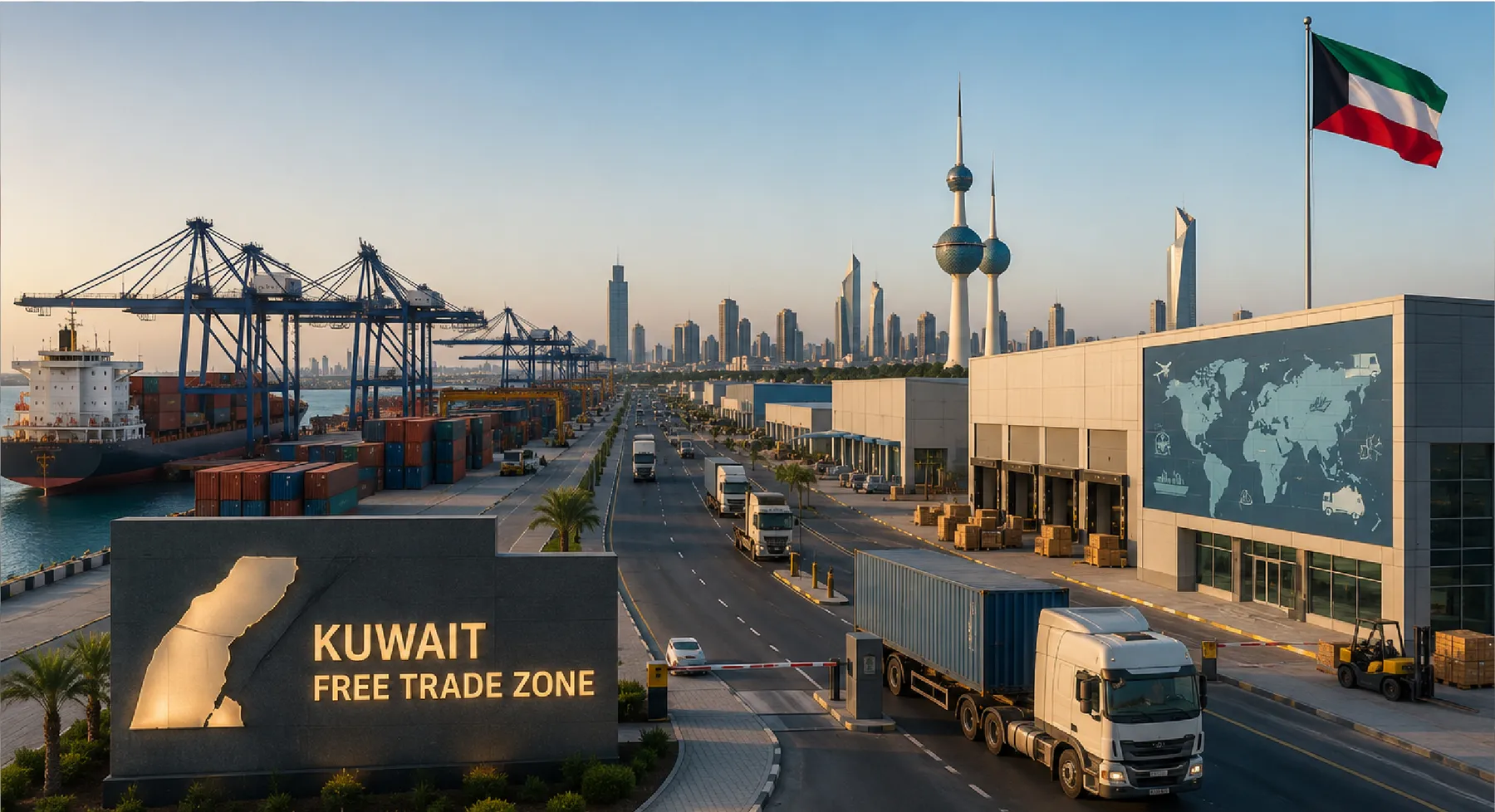
Kuwait sits at the centre of the Gulf Cooperation Council, sharing land borders with Saudi Arabia and Iraq and connecting to active Gulf shipping lanes. Businesses operating through a free zone in Kuwait can distribute goods across the GCC with far fewer trade barriers than through mainland commercial structures. As Kuwait continues implementing its national development agenda, free trade zones in Kuwait are receiving increased infrastructure investment, making the current period a strong window for businesses to establish a free zone presence. Company Formation Kuwait works with new market entrants and established regional companies alike to identify the right free zone structure for their activity type and ownership requirements.
Which Businesses Need a Kuwait Free Trade Zone Setup?
Businesses that gain the most from the Kuwait free zone advisory support include:
International producers establishing a Gulf‑based distribution or light‑assembly hub.
Import–export firms needing streamlined customs procedures and duty‑efficient operations.
Freight, warehousing, and supply‑chain companies seeking strategically located storage facilities.
Technology firms wanting 100% foreign ownership without requiring a local partner.
Regional entities consolidating GCC operations under a single, tax‑efficient structure.
First‑time investors exploring Kuwait through a low‑risk, flexible business model.
Online retailers requiring bonded warehousing, fulfilment support, and efficient last‑mile distribution.
Types of Kuwait Trade Zone Licences and Structures
Different business activities in Kuwait free zones fall under specific licence categories. Each licence type supports a different kind of operation and setup requirement.
Trading Licence
A trading licence within the free trade zone in Kuwait allows businesses to import, export, re-export, and distribute goods without paying standard customs duties on goods that do not enter Kuwait’s domestic market. This is the most widely used structure among companies in the Kuwait Trade Zone that use Kuwait as a regional trade corridor for Gulf or international distribution.
Industrial and Manufacturing Licence
Businesses involved in light manufacturing, product assembly, or processing operations can apply for an industrial licence inside the free zone. This structure is suited to companies that want to produce goods in Kuwait and export them to GCC partners or international markets. Industrial licence holders typically benefit from access to dedicated logistics infrastructure and subsidised utility arrangements.
Service and Professional Licence
Free zones in Kuwait also accommodate service businesses, including management consultancies, IT solution providers, and financial advisory firms. A service licence gives companies the flexibility to operate within the zone and engage international clients without the full regulatory requirements of mainland business registration in Kuwait.
Logistics and Warehousing Licence
For companies whose core requirement is storage, bonded warehousing, and onward distribution, a logistics licence provides dedicated warehouse space with direct port and airport access. This structure significantly reduces lead times for businesses that depend on frequent cargo movement in and out of the Gulf.
Benefits of Registering in the Kuwait Trade Zone
Free zones in Kuwait offer several operational and ownership advantages for international and regional businesses.
Full Foreign Ownership
One of the most significant advantages of the Kuwait trade zone is the ability for foreign investors to own 100% of their registered business. There is no requirement for a Kuwaiti national partner, giving international companies full control over their operations, profits, and strategic decisions from day one.
Customs and Tax Efficiency
Businesses operating in a free zone in Kuwait are typically exempt from import duties on goods used within the zone or re-exported to other markets. Combined with Kuwait’s zero corporate income tax environment, this creates a highly competitive cost structure for trade-focused companies looking to minimise overhead on their Gulf operations.
Faster Market Entry
Free zone registration in Kuwait follows a more streamlined approval process than mainland commercial registration. Most licence applications move through the system within a defined window, allowing businesses to begin operations quickly without extended government approval timelines.
Gulf Trade Corridor Access
Companies in the Kuwait Trade Zone gain access to some of the most active trade corridors in the Middle East. With direct connectivity to Saudi Arabia, Iraq, and major Gulf ports, Kuwait is a logical base for businesses that need to move goods efficiently across the region.
Common Challenges Businesses Face in the Free Trade Zone in Kuwait
Case 1
Uncertainty about which Kuwait free zone best suits your business model and ownership goal
Case 2
Difficulty interpreting free zone ownership rules, activity categories, and licensing conditions
Case 3
Delays caused by incorrect or incomplete documentation submitted to zone authorities
Case 4
Confusion between free zone and mainland commercial registration, and what each allows
Case 5
Unclear guidance on customs procedures, bonded warehouse use, and re-export protocols
Case 6
Challenges in opening corporate bank accounts for newly registered free zone entities
Case 7
Limited understanding of annual compliance requirements, licence renewals, and activity amendments
Case 8
Difficulty sourcing reliable local operational support once the free zone entity is active
Our Free Zone Setup Process
Setting up a company in Kuwait’s free zones follows a structured process that moves from planning to full operational status.
Initial Business Assessment
We begin every engagement by understanding your business model, ownership structure, trade activities, and operational priorities. Our advisors map your goals against the available free trade zone in Kuwait options in Kuwait and recommend the most appropriate zone and licence type for your specific situation.
Zone Selection and Pre-Approval
Once the right zone is identified, we guide you through the pre-approval process with the relevant free zone authority. This includes preparing an initial business profile, confirming that your activity falls within the zone’s permitted categories, and submitting the pre-approval request on your behalf.
Document Preparation and Submission
Our team prepares and reviews all required documentation, including shareholder identity documents, trade activity descriptions, lease preferences, and supporting corporate paperwork from your home country. We ensure every document meets authority requirements before the formal submission is made.
Licence Issuance and Bank Account Support
Following authority approval, we manage the licence issuance process and immediately begin supporting you with corporate bank account applications. Company Formation Kuwait works with banks that have established processes for free zone entities, which improves approval outcomes and reduces waiting time.
Post-Setup Compliance and Expansion Planning
Our support does not stop when your licence is issued. We provide ongoing compliance assistance, including annual renewal management, activity expansion guidance, and advice on scaling your Kuwait free zone operations as your business grows.
Schedule a Free Initial Consultation
Consulting Cost and Project Timeline
The cost of entering the Kuwait trade zone varies based on the licence type chosen, the size and location of office or warehouse space, and the number of shareholders in the structure. Company Formation Kuwait provides a full cost estimate during the initial consultation so you can plan your investment with confidence.
Estimated Timeline
6 to 10 weeks
Cost Range
1,800 – 3,500 KWD
Disclaimer: Please note that all timelines and cost estimates mentioned are indicative only. Final pricing and processing time are confirmed after an initial review of your business type, ownership structure, documentation status, and banking requirements.
Latest Reforms and Infrastructure Developments in Kuwait Trade Zones (2024–2026)
Kuwait’s free trade zones are evolving with new infrastructure projects and regulatory updates that enhance investor confidence. These reforms make entry into the Kuwaiti market more attractive for international businesses.
- Government-backed infrastructure upgrades in logistics and warehousing facilities
- Streamlined customs procedures aligned with GCC trade facilitation standards
- Expansion of bonded warehouse capacity for e-commerce and regional distribution
- Digitalisation of licensing and compliance processes for faster approvals
- Increased foreign investment incentives under Kuwait’s national development agenda

Documentation and Information Required
To initiate your free zone registration, you will typically need to provide the following:
Document / Information |
Purpose |
|---|---|
Passport copies of all shareholders
|
Identity verification for all business owners
|
Proof of residential or business address
|
Background verification for each applicant
|
Business plan or activity description
|
Authority review of permitted zone activities
|
Corporate resolution or NOC (if applicable)
|
Confirms signatory authority for the company
|
Proposed company name options
|
Name reservation with the free zone authority
|
Office or warehouse space preference
|
Confirms physical presence arrangement
|
Regulatory Authorities Governing Kuwait Free Trade Zones
Free zone operations in Kuwait are managed by key government and regulatory bodies that oversee licensing, customs, and compliance.
Kuwait Free Trade Zone Company (KFTZC)
The Kuwait Trade Zone Company is the principal authority responsible for managing and operating free trade zones within Kuwait. It oversees licensing approvals, lease arrangements, and operational permissions for all registered zone entities. KFTZC works in coordination with Kuwait Customs and the Ministry of Commerce and Industry on matters that touch both free zone and national trade regulations.
Ministry of Commerce and Industry (MOCI)
While free zone businesses operate outside the standard mainland registration system, certain business activities and company structures still require coordination with MOCI regulations. Our advisors ensure your free zone setup is structured in a way that meets all relevant ministerial requirements and avoids future compliance complications.
Kuwait Customs Authority
All goods entering or exiting the trade zone pass through Kuwait Customs oversight. Understanding customs classification, bonded warehouse protocols, and re-export documentation is essential for any trade-focused free zone business. Our team helps clients prepare the correct customs paperwork and understand the applicable procedures so goods move efficiently without unnecessary holds or penalties.
Sectors We Work With
Company Formation Kuwait supports free zone registrations across a broad range of industries:
Logistics, freight forwarding, and supply chain management
Light manufacturing, assembly, and industrial processing
Food and beverage import, export, and regional distribution
Healthcare equipment and pharmaceutical product supply chains
Retail e-commerce fulfilment and last-mile distribution operations
Why Businesses Choose Company Formation Kuwait for Free Trade Zone Setup?
Companies working with Kuwait free zones often need clear guidance, smooth coordination, and reliable handling of approvals. Company Formation Kuwait supports businesses through each stage of the setup with structured advisory and direct coordination with local authorities.
Kuwait-specific expertise: Our advisors focus on Kuwait and GCC business setup. You receive current, market-specific regulatory intelligence rather than generic Gulf advice that may not apply to your situation
Complete end-to-end management: Company Formation Kuwait handles every step from zone selection through to licence issuance and bank account opening, eliminating the need to coordinate between multiple service providers
Authority relationships: Our sustained working relationships with the Kuwait trade zone authorities mean our document submissions are structured correctly from the outset, reducing delays caused by back-and-forth corrections
Transparent cost estimates: We provide detailed cost breakdowns at the start of the engagement, so there are no unexpected fees once the process is underway
Ongoing compliance support: Our involvement continues well beyond setup. We manage annual renewals, activity amendments, and long-term expansion planning for clients operating in the free zone
Arabic and English advisory capability: Our team communicates directly with local authorities in Arabic, removing the language barrier that often slows down the registration process for international clients
Note: The above-mentioned services are provided via network firms if not provided directly
Client Success Story
The Challenge
A European-based trading company approached Company Formation Kuwait after an unsuccessful attempt to structure a mainland Kuwaiti registration. The company needed full foreign ownership, a fast licensing timeline, and direct access to GCC export routes. They had no prior experience with Kuwaiti free zone regulations and were unclear about which documents were required or which authority to approach first.
Our Approach
Our team conducted a structured assessment of the client’s trade activities, product categories, and intended GCC distribution markets. Based on the analysis, we recommended a trading licence within one of Kuwait’s established free trade zones. We prepared the complete documentation package, coordinated all submissions with the zone authority directly, and handled follow-up queries on the client’s behalf. When the bank account application encountered early difficulty, our advisors provided supplementary documentation and engaged the relationship manager at the bank to clarify the business structure.
The Outcome
The company received its free trade zone licence within six weeks of starting the process with Company Formation Kuwait. The corporate bank account was approved and activated two weeks after that. Within the first three months of operation, the client had established active export routes to two GCC countries and was moving goods at a substantially lower customs cost compared to their previous regional arrangement. The client subsequently expanded their warehousing capacity within the same zone.
Start Your Kuwait Trade Zone Journey with Company Formation Kuwait
If you are ready to explore the Kuwait free trade zone as a foundation for Gulf operations, Company Formation Kuwait is prepared to guide you through the entire process. Our team manages the regulatory complexity so you can focus on building your business, not navigating paperwork. Speak with a Kuwait free zone specialist today and get a clear, step-by-step plan adapted to your business.
FAQs
Can a foreign company own 100% of a free zone business in Kuwait?
Yes. Foreign investors can fully own companies in the free trade zone in Kuwait without needing a local sponsor. This setup gives complete control over operations and profits.
What types of businesses can register in a free trade zone in Kuwait?
Businesses like trading, logistics, manufacturing, services, and e-commerce can register in free zones. Eligibility depends on zone rules and approved activity categories.
Can free zone companies trade directly inside Kuwait’s local market?
Generally, free zone companies focus on import, export, and re-export activities. Selling directly in the local market usually requires additional approvals or a mainland structure.
What is the difference between a free zone and a mainland company in Kuwait?
Free zone companies enjoy customs advantages and full foreign ownership rights, while mainland companies follow standard commercial laws and may need local ownership in certain sectors.
Is office space required to register in a free trade zone in Kuwait?
Yes, most free zone setups require a registered office or warehouse space within the zone. The size and type depend on your business activity.